
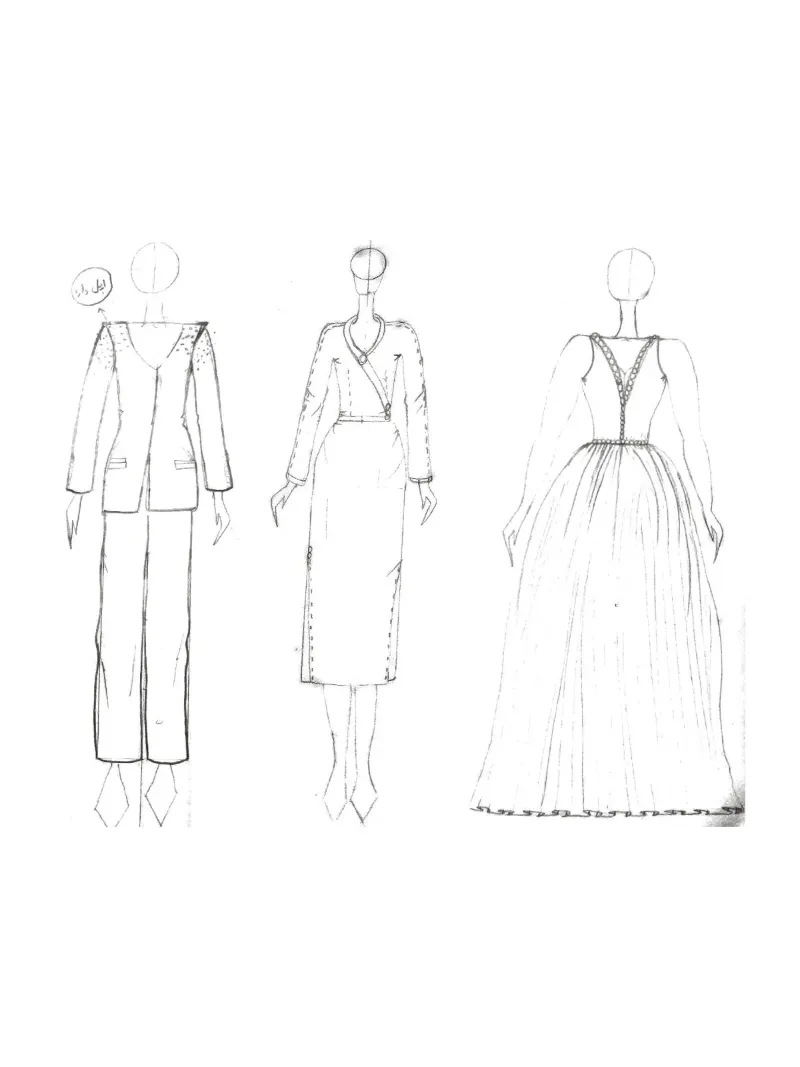
In my design studio, before the first line goes onto paper, one question comes first: what balance is this garment meant to create? No figure is "bad" or "difficult". Every body has its own proportions, and the designer's work is to understand them and guide the viewer's eye — to highlight here, to let it rest there, and to arrive at an image that feels unified, elongated and assured. In this article I walk through the principles of choosing a formal suit or set for three common body shapes, illustrated with sketches from my own design notebook.
First of all: know your shape
Body shape has nothing to do with weight; it is about the relationship between four key measurements — shoulder width, bust, waist and hips. Simply ask yourself where your body is widest and how much narrower your waist is than your bust and hips. Many women combine two shapes, and nobody needs to fit into a closed box; these categories are only the starting point of a conversation. In a consultation, that first understanding is completed by precise measurements and the designer's eye.
The pear figure: balance through a confident shoulder
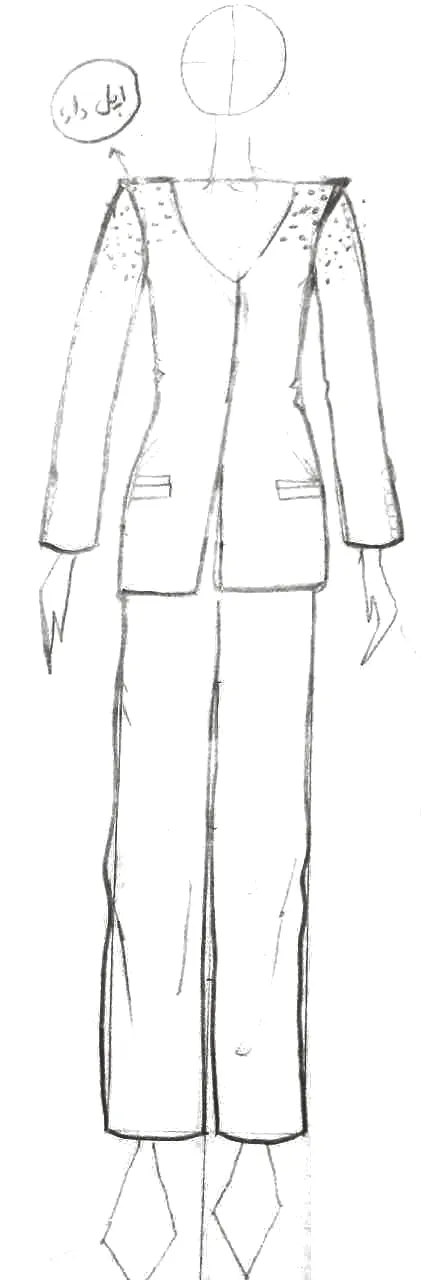
In a pear figure the hips and thighs are wider than the shoulders, and the upper body is more delicate. The aim is visual balance between top and bottom — not hiding anything, but giving both halves equal weight.
A structured shoulder
Shoulder pads, and even a subtle embellishment at the shoulder, are more than a visual choice: they lend the wearer a commanding stance and draw the eye upwards. The handwritten note beside the shoulder in this sketch — "with shoulder pads" in Persian — points to exactly that. A shoulder like this helps you carry yourself with greater confidence in formal and professional settings.
A jacket that frames
A jacket gently fitted at the waist, long enough to reach over the hips, works like a frame around the figure: it follows the curve of the sides without emphasising it. A deep V neckline stresses length rather than width — the real secret of looking longer and leaner. Avoid large flap pockets placed right at the widest point of the hips.
Trousers that form a column
Long, straight-leg trousers do not reveal the exact shape of the legs; instead they create a clean, elongated column. A slightly higher rise and a sharp crease add to the effect, so the figure reads as considerably taller than it is.
Cloth and colour
For the jacket, a cloth with a little sheen or texture — a jacquard or a heavy crepe — makes the shoulders look fuller. For the trousers, a fabric with good drape in a solid dark shade such as navy, charcoal or black makes the lower body look more compact.
The apple figure: the power of diagonal and vertical lines
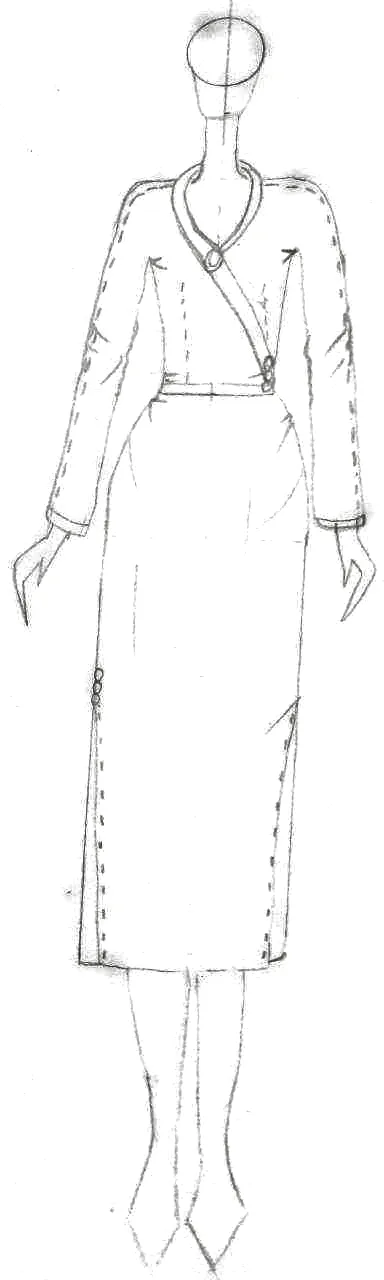
In an apple figure, most of the volume sits around the middle — the stomach and sides — while the legs and arms are usually slimmer. The design goal is to soften the horizontal line of the waist and build a vertical line that lengthens the whole silhouette.
The diagonal line
A wrap or crossover front is one of the cleverest choices for this figure. The diagonal it draws across the body breaks up the width of the torso and takes the focus away from the stomach, so the waist reads as narrower than it is. You will find the same logic in the angled hem of the Sana waistcoat.
The strength of a V neckline
A long V neckline makes the neck look longer and leads the eye upwards, towards the face; as a result, the middle of the body attracts less attention.
Vertical lines
A row of buttons or trim running down the side of a skirt or along the front of a garment creates a vertical line. The eye travels along it, the lower body looks longer, and the width of the hips goes unnoticed at first glance.
A flat waist — no gathers, no pleats
Skirts and trousers should sit flat at the waist, without gathers, pleats or puffing; any volume there adds visual weight. For the jacket, a single-button or concealed-button style long enough to reach over the hips, skimming past the stomach, works better than a short or belted jacket.
Cloth and colour
Fabrics with good drape, such as crepe or soft wool, settle on the body without adding bulk; leave stiff, rigid cloth aside. Keeping top and skirt in the same colour family makes you look taller; if you want contrast, choose a slightly darker skirt. A midi skirt, at or just below the knee, balances best with the upper body.
The inverted triangle: softness above, volume below
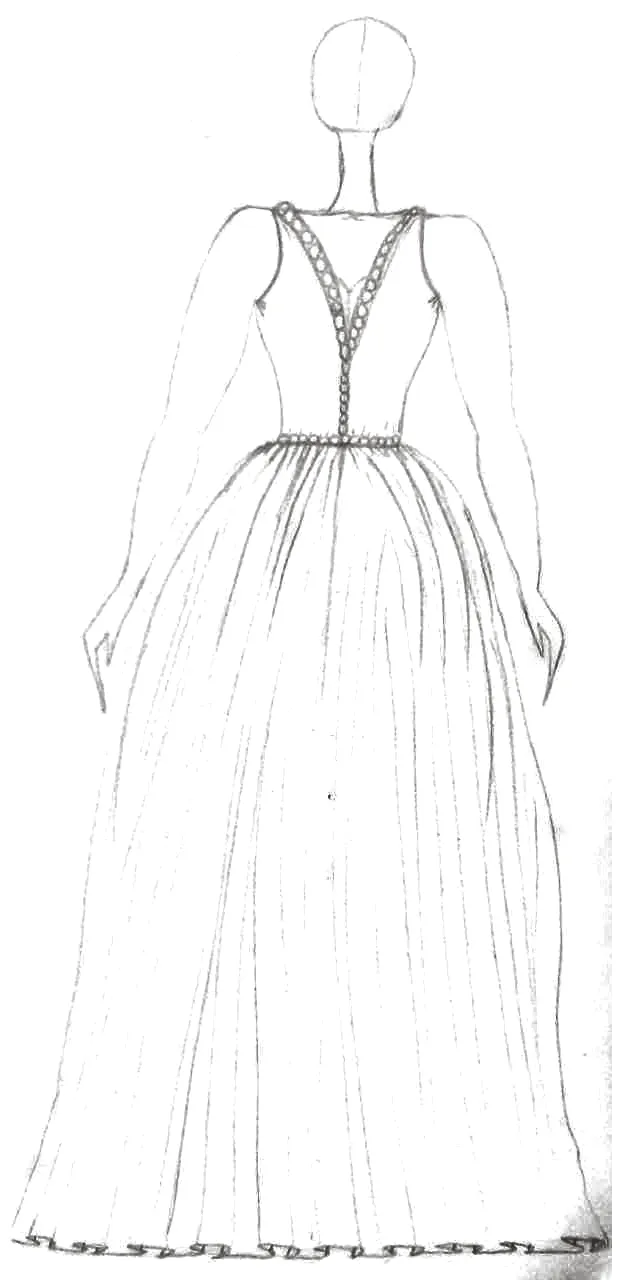
Here the shoulders and bust are wider than the hips. The aim is to reduce the horizontal width of the shoulders and add volume below, moving the proportions closer to an hourglass. The sketch in this section is an evening design from my notebook, but the principles behind it work just as well in a formal suit.
The magic of the neckline
A deep V draws the eye from the outer edges of the shoulders towards the centre and breaks their horizontal line. In a formal jacket, a long lapel whose roll reaches below the bust does the same job.
Volume below
The real challenge of this figure is a narrow lower body. A gathered or flared skirt that starts at the waistline, or wide-leg trousers, supplies exactly the volume the hips lack and brings the lower half into balance with the shoulders.
Emphasis on the waist
A slim belt or a detail at the narrowest point of the body becomes the focal point of the design: the eye goes first to the slender waist, and the balance between top and bottom becomes clearer. A jacket with a defined waist or a short peplum plays the same role.
Soft shoulders and fine straps
Unlike the pear figure, this shape has no need for shoulder pads or puffed sleeves. A natural, soft shoulder — and, in sleeveless pieces, slim straps — keep the shoulders delicate, while wide boat necklines make them look broader. A lighter or textured colour below and a dark, plain colour above complete the balance.
What bespoke adds to these principles
These rules are a starting point, not a fixed prescription. No two bodies are alike: one shoulder may sit slightly lower than the other, and the way each of us stands changes how a garment falls. In bespoke tailoring these details are noticed at the measuring stage and refined on you at the first fitting and the final fit. If you would like both a skirt and trousers to choose between, a set such as Artadokht offers both alongside its jacket and waistcoat. Explore more designs in the Power Suit Collection, and contact us for a consultation on your figure.